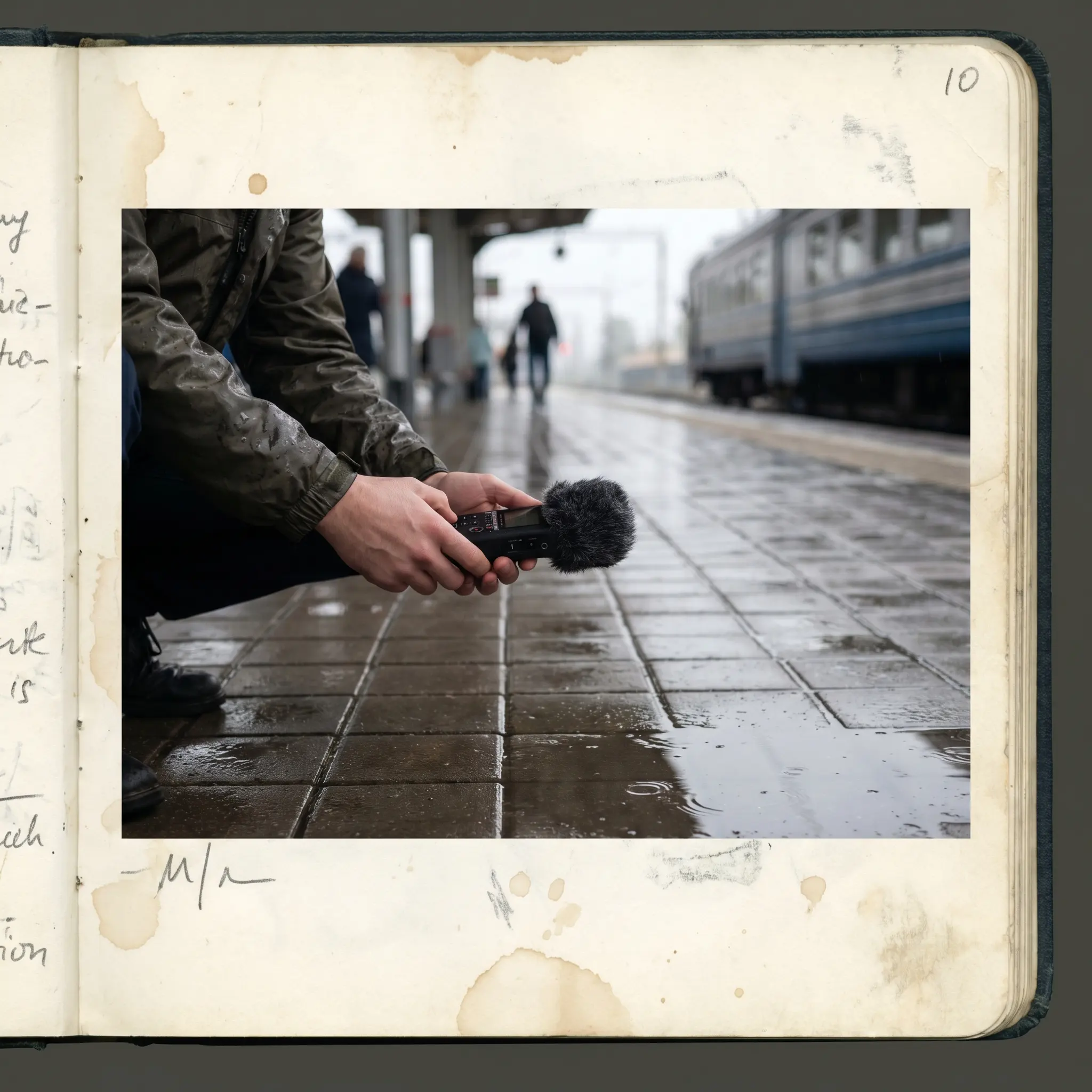
field notes
Portable prompts for listening outside the studio.
Soriu field notes are designed for ordinary places: a market entrance, a stairwell, a late bus, a shared office, a laundromat, a classroom just before the bell. The notes favor short observations because short observations travel well. They fit in the margin of a planner, the title of an audio file, or the memory of a walk home.
The practice is not about hunting for spectacular sound. It is about recognizing how routine acoustics organize behavior. A floor tells people whether to whisper. A ventilation fan hides a private sentence. A crossing signal gives strangers a shared tempo. When these details are written down, they become evidence for design, teaching, writing, and everyday care.
01
Write down the first sound that repeats and the first sound that refuses to repeat.
02
Mark where a sound becomes useful: a door click, crossing chirp, elevator chime, or kettle pitch.
03
Describe one silence as a material condition rather than an absence.
04
Notice which sound makes people change speed before they consciously react.
A note should keep the place attached
A detached sound label rarely helps later. "Hum" is weaker than "low refrigerator hum that made the small shop feel occupied before anyone spoke." Soriu notes keep the source, the behavior, and the effect together, so a reader can understand why the sound mattered without hearing the original file.